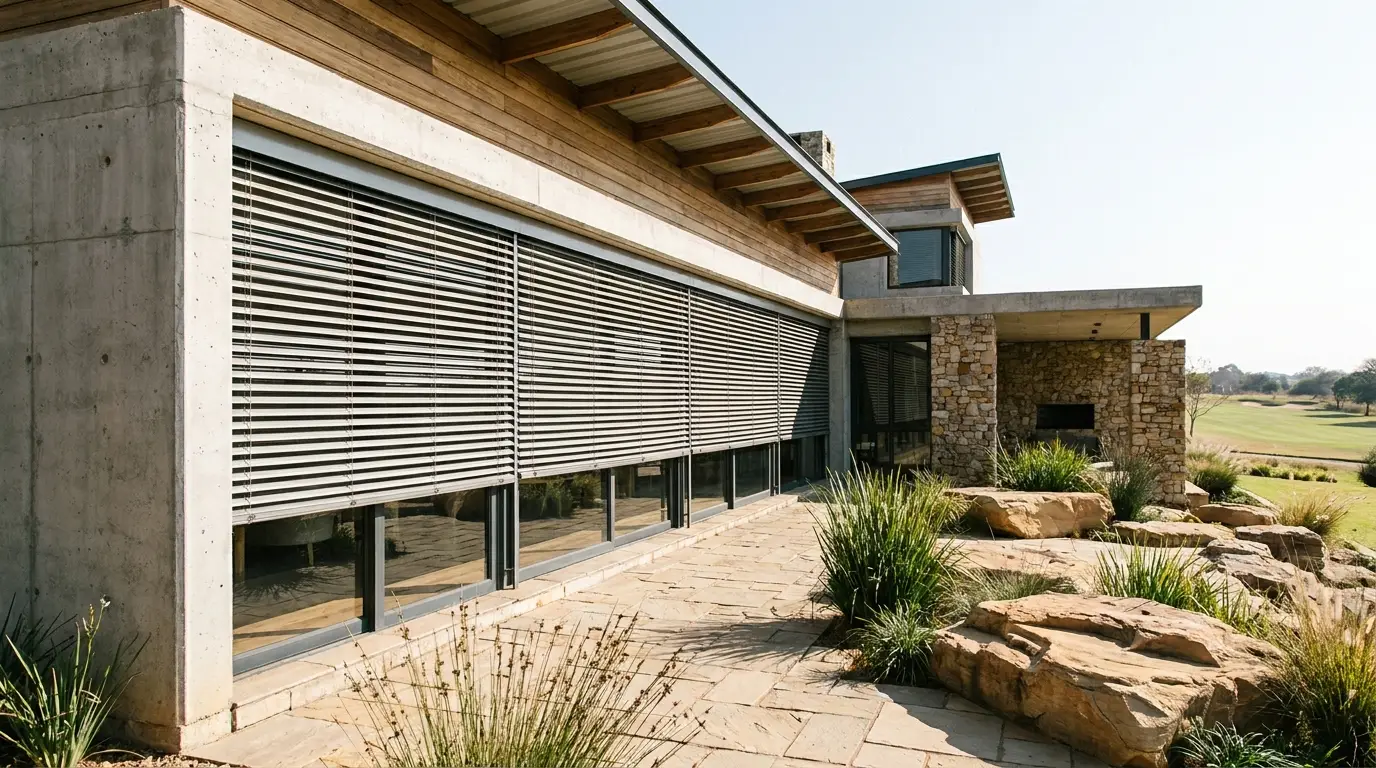
Every wall here was built to face the canyon, not the sun.
What we've worked out about sun, wind and glass on a house that looks into an old granite quarry: which wall catches it and when, what we'd put on each, and the five things only a tape measure can settle.
Roughly a nine-minute readSources listed at the footNothing gated, nothing to fill in
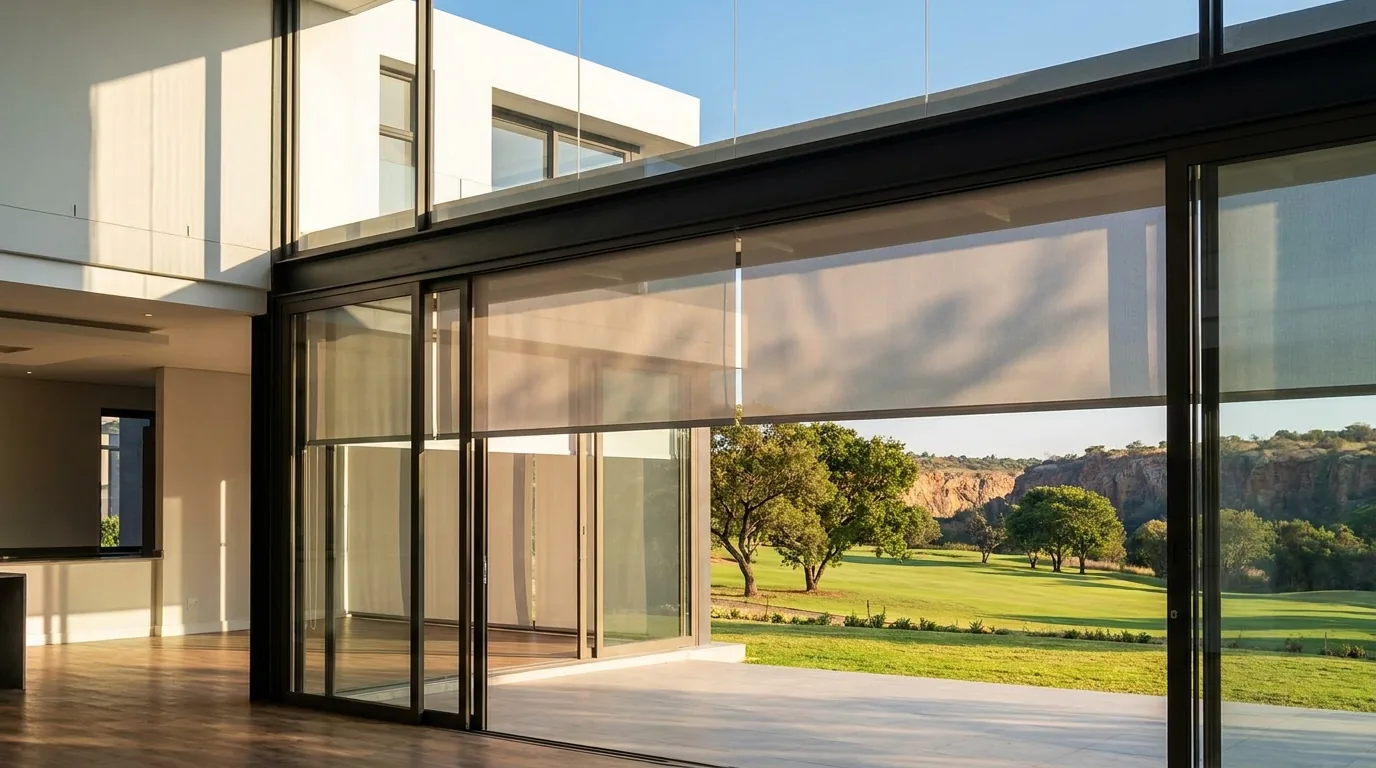
Half-drawn sunscreen on the fairway wall — the glare goes, the canyon stays in view.
Not your average street grid
Built to face the canyon. Compass be damned.
Eagle Canyon sits on roughly 300 hectares of Honeydew ground that spent about forty years as a working granite quarry before it stopped paying to dig. When the quarry closed in the early 2000s, the developer kept the hole rather than filling it back in — the eighteen-hole, par-72 course runs straight through the old rock faces and the water that collected in them, which is why so many stands look down into sheer quarried walls instead of a normal fairway's flat grass verge.
That history decides how the houses are built. Stands here are angled at the fairway and the canyon, not at north — and on the roughly 71% of the estate's 1,391 properties that are freehold, close to a thousand square metres gave architects room to turn the glass toward whichever direction the view happened to sit. Compass direction became a secondary concern, and on a house with floor-to-ceiling stacking doors, that's a specification problem before it's a design one.
The other 29% — sectional-title townhouses on 250–500m² stands — face the same problem on a smaller footprint, often with a shared sightline down the cart path a freehold stand doesn't have to think about.
The light
Twenty-six degrees south, and a sun that swings 46° between solstices.
Roodepoort sits at roughly 26.19° south and 1,700m above sea level. Both numbers show up in the same specification, at opposite ends of the year.
Midsummer: overhead, then gone wide
At the December solstice the sun rises at 05:12 on a bearing of 116° and sets at 18:59 on 243°, peaking at roughly 86° at solar noon — close enough to overhead that flat and double-volume glass takes the brunt of it. Both ends of that 13-hour-47-minute day land well south of due east and due west, so a wall you'd assume gets no morning or evening sun usually does.
Midwinter: low, wide and welcome
By the June solstice sunrise has swung back to 64° and sunset to 295° — a 46° shift from summer — while solar noon reaches only about 40° and day length drops to 10 hours 30. With July lows near 1.7°C, low winter sun reaching deep into any north-facing room is free heating, not a nuisance.
The west-swing problem
Sunset's bearing moves between 243° in December and 295° in June, so any wall facing anywhere from south-west round to north-west catches direct, low-angle sun at the end of every single day, twelve months of the year. It's the one elevation with no seasonal relief.
Storms decide what survives outside
Gauteng's supercell season peaks in October and November, tracking at roughly 41km/h over about 49km — long enough to cross the whole estate — and September is the windiest month, averaging 15.1km/h. Anything left extended outside the glass needs to retract itself before the gust arrives, not after.
Room by room
Four walls — and which one is actually yours depends on your stand
Work out which compass direction your view wall faces, then read the matching section below — that's the one variable a street address here won't tell you.
North
The wall to protect, not block
Winter sun arrives low and useful, warming rooms through a cold Highveld July. Summer sun on the same wall sits close to overhead, so a retractable answer keeps the winter gain and loses the summer heat.
What we'd fit: something you can open again by June — external venetians or a motorised sunscreen.
West
The one with no season off
Sunset's bearing stays between 243° and 295° all year, so a west-facing wall gets low, direct sun at the end of every single day. By four o'clock this is usually the room nobody's sitting in.
What we'd fit: stop it outside the glass — an interior blind still leaves a hot pane radiating into the room after the sun's gone.
East
An early problem, not a hot one
Midsummer sunrise lands at 05:12 on a 116° bearing — south enough of due east to reach bedrooms most owners assume are shielded. A wake-up-too-early issue more than a heat one, since the morning air is still cool.
What we'd fit: a blockout layer for anyone who wants to sleep past sunrise.
South
Little direct sun, plenty bounced
A south wall sees almost no direct light at this latitude, but the fairway grass, the estate's water features and the pale quarried rock throw glare back up into the room most of the day.
What we'd fit: an open-weave sunscreen — the glare needs killing even where the sun itself never reaches the glass.
What we'd fit, and why
The reasoning — and the honest catch with each
Each beats its obvious alternative on a particular wall, and each costs you something — the catch sits right next to it. Tap Add to my window list to carry it down to the form at the foot of the page.
Roller blinds — sunscreen and blockout
Best on: the view wall (sunscreen) · bedrooms (blockout)
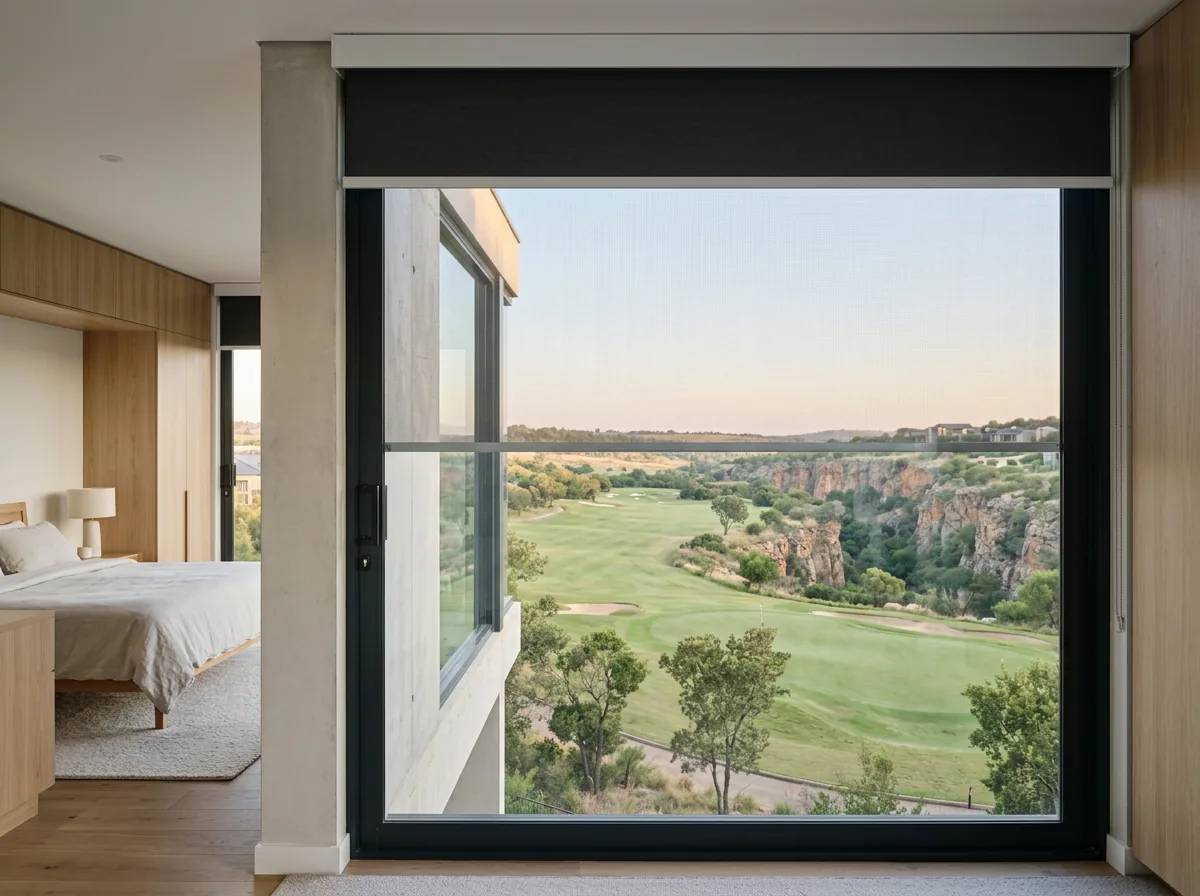
Why here. A low-openness sunscreen is a flat mesh panel on a tube — glare and UV drop while the fairway and canyon wall stay readable through it, which matters when the view is why the stand cost what it did. Blockout does the opposite: total dark for a bedroom catching first light at 05:12 in midsummer.
The catch. Sunscreen reverses after dark, showing more of a cart-path-facing room than expected once the lights are on. Blockout alone loses the view by day — most view-wall bedrooms run both on one headrail.
Day/night zebra blinds
Best on: rooms overlooking the cart path
Why here. Alternating sheer and solid bands move from open view to eye-level privacy without fully closing — useful on smaller sectional-title stands, where a neighbour's window or the cart path sits closer than on a freehold stand.
The catch. Never a true blockout, and the banding is a strong pattern against the estate's clean, Bauhaus-leaning lines.
Aluminium & timber venetian blinds
Best on: kitchens/bathrooms (aluminium) · studies (timber)
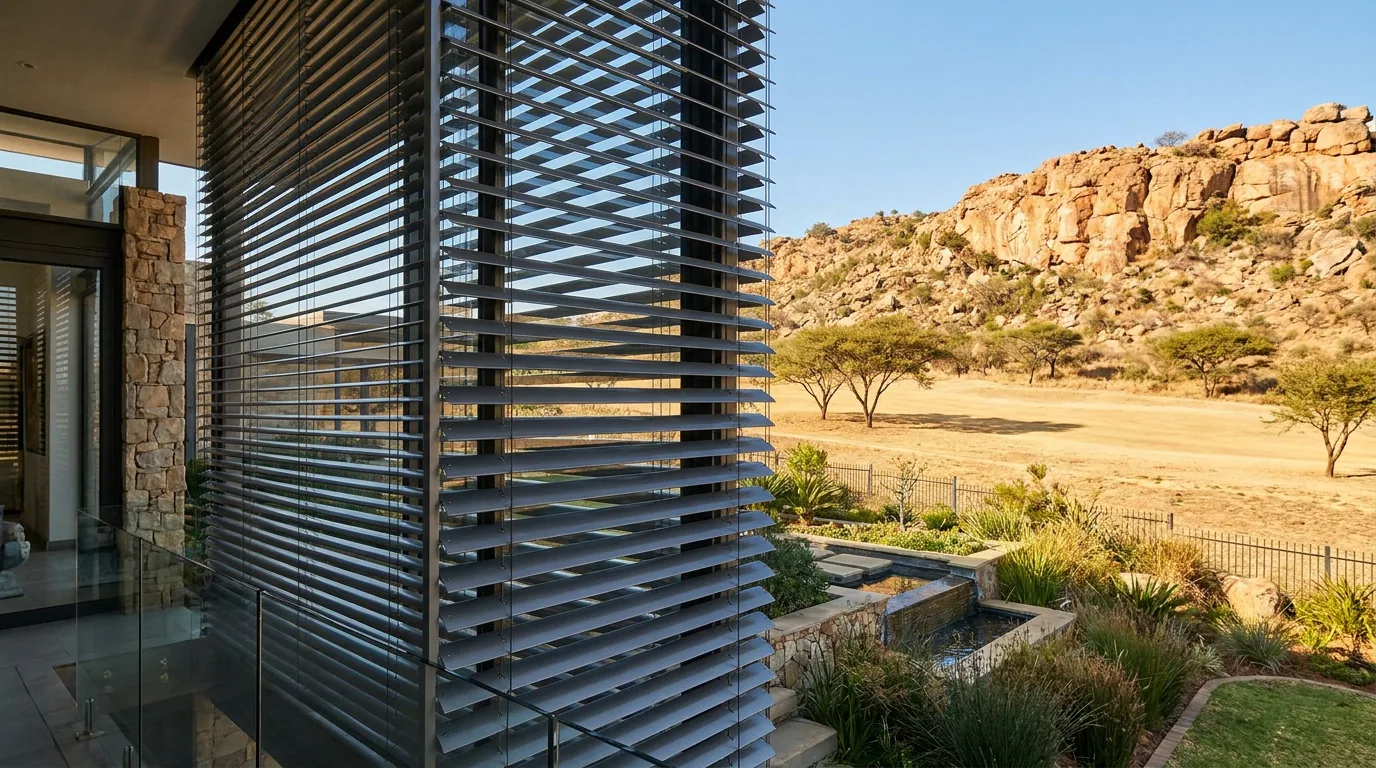
Why here. A tilting slat answers low sun sideways — close the angle and the beam stops while the room stays bright, which a roller's single up-down move can't match. Aluminium shrugs off moisture and Highveld dust; timber warms a Bauhaus-leaning study instead.
The catch. Aluminium reads coldly in a formal room; timber won't take a bathroom's steam or a kitchen splash zone. Pick by room, not preference.
Vertical & panel blinds
Best on: wide stacking or sliding doors
Why here. Vanes and sliding panels cover a three- or four-metre opening edge to edge and draw clear of the door — necessary on the full walls of stacking glass this estate is built around.
The catch. Vanes sway in the draught of an open door, and a panel blind needs wall to stack onto — at a corner, a wide roller usually wins instead.
Cellular honeycomb blinds
Best on: the coldest rooms, or glass you won't replace
Why here. The fabric folds into cells that trap still air against the pane — worth having with July lows near 1.7°C, radiating heat straight back out overnight under clear skies.
The catch. It sits on the wrong side of the glass for the west wall's year-round low sun. Against that elevation, an exterior product wins instead.
Concealed / recessed blinds
Best on: architect-finish, double-volume rooms
Why here. The blind drops from a slot in the ceiling line, leaving nothing to interrupt the fairway sightline a double-volume, Bauhaus-leaning room is usually built to show off.
The catch. It has to be designed in before the ceiling closes — not something a finished bulkhead can take on later.
External venetian blinds & roller shutters
Best on: the west wall, or unshaded glass
Why here. Both stop the sun outside the glass — a different result from stopping it inside. An interior blockout kills glare the moment it's down, but the pane behind it keeps radiating heat after sunset, and the west wall here catches low sun at the end of every day, all year. External venetians tilt, so a view survives; roller shutters close down flat into a compact headbox.
The catch. The dearest answers here, in relative terms. Both want a motor and a wind sensor through the October–November storm season, and both are exterior alterations on an estate that likely has a say over anything visible from the fairway.
Shading, not security. Our roller shutters are made for sun, heat and glare control on the outside of the glass. They are not security-rated shutters — that's a different product, which we can quote on request.
Folding-arm patio awnings
Best on: the entertainment patio
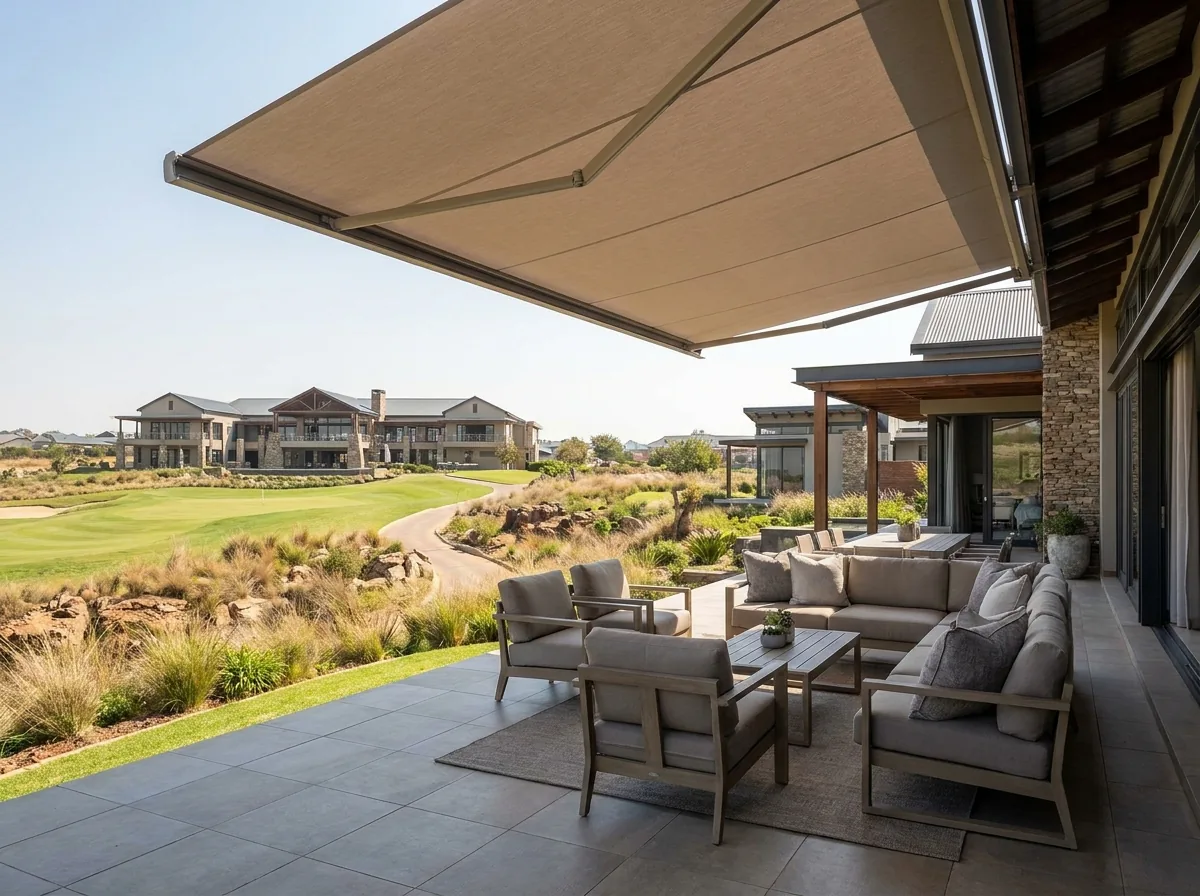
Why here. Articulated arms shade the patio on demand with nothing standing on the paving, then fold flat in winter to let that low, welcome sun back onto the same spot — a fixed roof can't do both.
The catch. Wind and hail ratings are engineering limits, not marketing copy — an awning caught open when a supercell gust hits at 41km/h won't survive it. We'd rather specify a motor and wind sensor that retracts it unattended than a manual crank someone forgets.
Motorisation & automation
Best on: wide stacking glass, anything above reach
Why here. A wall of six blind panels runs far easier from one remote or app than six separate chains, and outdoors it isn't a convenience — a wind sensor retracts an awning or external venetian before the gust arrives, including while nobody's home.
The catch. Motors need power, and on an already-finished house, a cable route that avoids chasing a wall is a real on-site question.
The bit people forget
Outside the glass is where the estate has a say.
Optional
Want this guide marked up for your own stand?
Tell us which walls are the problem and we'll send this back with notes against your actual elevations — which of the above we'd start with, and which we'd leave alone. No visit, no obligation.
The estate's own say
What the aesthetics committee likely governs — and what we couldn't verify
Golf estates at this scale almost always run an architectural or aesthetics review process over anything visible from outside — exterior colours, awning fabric and roller shutter finishes included. We looked for Eagle Canyon's own published guideline document and couldn't find one online, unlike some estates that publish theirs in full, so we won't pretend to quote a clause that isn't public.
What that means in practice: before anything exterior goes on order, we check the current committee requirements with you and hold a fabric or colour reference ready for sign-off. It costs a few days and saves a re-manufacture — worth doing even on a sectional-title unit, where the body corporate usually runs a similar approval.
Honest limits
Five things this page can't settle from here
Everything above is reasoning from research. These five are measurements, and they routinely change the recommendation — which is why the measure is free.
The reveal depth, and what the frame takes
How deep the opening is, and whether the frame will take a fixing, decides inside-mount versus outside-mount — and whether a blockout blind leaves a light line down its edges. Not something a photo can tell us.
Which wall is actually yours
Sun-path figures describe the sky, not your stand. Whether your view wall reads as north, west or somewhere between depends on how your house sits against the canyon.
Wind exposure at your specific corner
Two patios on the same road behave differently depending on how the canyon walls and water funnel the wind past them — a reading that sets the awning size and arm projection.
Power, and the route to it
Every motorised decision comes back to where a cable can go without chasing a finished wall — mains versus battery, and eyes on the ceiling void.
What the committee currently requires, and what's already approved next door
Guideline revisions change, and a neighbour's already-approved colour or fabric is the fastest route through a review.
Two ways forward
Have us come and measure — or get a range first
Both start on the one short form below.
Recommended
The free expert measure & written quote
A consultant walks your actual walls at the hour that bothers you, measures every opening and leaves a written quote itemised per window. Free, nothing owed at the end.
We take five or six measure appointments a week across Eagle Canyon and the surrounding West Rand estates, so the diary fills early.
Pop in rough sizes and we'll send a budget range by the next working day. Not sure how to measure? Leave it — our consultant measures for free either way, and that's where exact per-window pricing comes from.
We couldn't find a published Eagle Canyon architectural or aesthetics guideline document online — see the estate section above for what that means for anything exterior.